What you will learn
-
Project Management Fundamentals & PMBOK® Framework
-
PMI Project Management Principles
-
Project Life Cycles & Development Approaches
-
Project Scope & Requirements Management
-
Project Cost & Financial Management
-
Resource & Team Management
-
Project Risk & Uncertainty Management
-
Stakeholder Management & Engagement
-
Project Performance Measurement & Reporting
-
Hybrid Project Management
-
PMI Framework & Evolution
-
Project Performance Domains
-
Business Environment, Governance & PMO
-
Project Schedule Manage
-
Project Quality Management
-
Project Communication Management
-
Contract Management
-
Project Change Management
-
Agile Project Management & Scrum
-
Project Completion and Handover
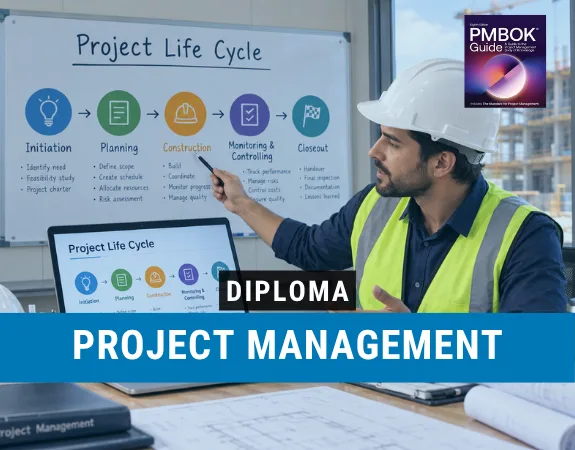
This Diploma in Project Management has been carefully designed to provide a comprehensive, practical, and structured understanding of modern project management, from fundamental principles to advanced professional practices. If your goal is to become a professional Project Manager and understand how successful projects are planned, executed, monitored, and completed in real-world environments, this course is built for you. It is not just a theory-based program; it is a practical learning experience designed to help you develop the knowledge, skills, and confidence required to manage projects effectively across different industries.
This course is designed to help you become a job-ready Project Management Professional with strong planning, organizational, analytical, and leadership skills. You will learn project management fundamentals, PMI project management principles, project life cycles, development approaches, scope and requirements management, cost and financial management, schedule management, resource allocation, quality management, and project communication. The course also covers risk and uncertainty management, stakeholder engagement, performance measurement and reporting, contract management, change management, project governance, and project completion and handover. Each topic will help you understand how different project management functions work together to achieve successful project outcomes.
If your goal is to find a job, improve your current professional skills, advance your career, manage construction and engineering projects, or prepare for internationally recognized project management opportunities, this course provides a valuable foundation for your professional growth. You will develop the ability to understand project requirements, prepare and manage plans, coordinate teams, control budgets and schedules, identify potential risks, and communicate effectively with stakeholders. These skills can help you take on greater responsibilities and pursue opportunities across construction, engineering, business, consultancy, and other project-driven industries.
The course is aligned with the PMBOK® Guide, Eighth Edition, and introduces you to the PMI project management framework and its evolution. You will explore project performance domains, business environment considerations, governance structures, and Project Management Offices (PMOs). This training is designed to help you understand the principles and professional practices that guide modern project management, enabling you to move beyond theoretical knowledge and develop a clearer understanding of how projects are managed in professional environments.
You will also learn how to apply Predictive (Waterfall), Agile, and Hybrid project management approaches according to project requirements and organizational needs. The course introduces Agile project management and Scrum while explaining how traditional and adaptive methods can be used to manage different types of projects. You will understand when each approach may be appropriate, how project teams can respond to changing requirements, and how effective planning, monitoring, and control contribute to project success. The emphasis is on practical understanding and application rather than memorizing concepts alone.
This course is suitable for learners at different stages of their careers. Whether you are an aspiring or experienced Project Manager, Project Engineer, Planning Engineer, Project Controls Professional, Construction or Engineering Professional, PMO Professional, Business Analyst, Team Leader, Consultant, or PMP® aspirant, the training can help strengthen your professional capabilities. You will gain a broader understanding of project management responsibilities and develop transferable skills that can be applied across different sectors, organizations, and project environments worldwide.
The training also emphasizes the importance of managing projects throughout their complete life cycle, from project initiation and planning to execution, monitoring, controlling, and closure. You will learn how to manage scope, schedule, cost, quality, resources, risks, stakeholders, communications, and contractual obligations while responding to changes and maintaining project performance. By understanding these interconnected areas, you can develop a more systematic approach to decision-making, problem-solving, coordination, and project delivery.
The course is designed to support both professional development and long-term career growth. By building a strong foundation in project management principles, frameworks, and methodologies, you can improve your ability to contribute to project teams, support organizational objectives, and pursue more advanced responsibilities. The knowledge gained can also support your preparation for project management certification pathways, including the PMP® credential, although completing the course alone does not guarantee certification eligibility or employment.
Enroll in the Diploma in Project Management by Noble QS to strengthen your project management knowledge, improve your professional confidence, and develop practical skills for today's competitive job market. Whether you are entering the profession or looking to enhance your existing experience, this course will help you build a structured understanding of modern project management and prepare for greater professional opportunities.
Note: This course supports PMP® aspirants by introducing key project management concepts and frameworks. Please check PMI's current eligibility requirements and examination guidance before applying for certification.

What is a Portfolio?
What is a Program?
Portfolio, Program, and Project: Comparison
Operations vs Projects
Project Constraints and Trade-offs
PMI Value Delivery System
Project Management Approaches
Project Management Approaches
PMBOK® Framework Structure
PMI Standard vs PMBOK® Guide
Project Life Cycle (High-Level)
Stakeholders and Their Influence
Organizational Structures
Role of the Project Manager
Enterprise Environmental Factors (EEFs) & Organizational Process Assets (OPAs)
Tailoring in Project Management
Evolution from PMBOK®
Shift from Process-Based to Principles-Based Managemen
Role of Performance Domains in Modern Project Management
The 8 Performance Domains
PMI Talent Triangle
Project Performance Standards
Models, Methods, and Artifacts
PMI Code of Ethics & Professional Conduct
Introduction to PMI Project Management Principles
Principle 1: Stewardship
Principle 2: Team
Principle 3: Stakeholders
Principle 4: Value
Principle 5: Systems Thinking
Principle 6: Leadership
Principle 7: Tailoring
Principle 8: Quality
Principle 9: Complexity
Principle 10: Risk
Principle 11: Adaptability & Resilience
Principle 12: Change
Project Vision and Objectives
Business Case Development
Financial Evaluation (NPV, IRR, Payback, BCR)
Strategic Alignment and Benefits Focus
Governance Frameworks
Decision Escalation & Authority Levels
PMO Types and Roles
Project Manager Responsibilities
Schedule Planning
Activity Definition
Network Diagrams (Precedence Diagramming Method – PDM)
Critical Path Method (CPM)
Leads, Lags, Float Types
Schedule Compression (Crashing & Fast-Tracking)
Rolling Wave Planning
Agile Iteration Planning
Gantt Charts & Milestones
Introduction
Risk Management Principles
Risk Identification Techniques
Risk Register Development
Qualitative Risk Analysis
Quantitative Risk Analysis
Risk Response Strategies
Risk Response Strategies
Risk Monitoring and Control
Opportunity Management
Risk Burndown Charts
Monte Carlo Simulation Concepts
Introduction of Stakeholder
Stakeholder Identification
Stakeholder Register
Power–Interest and Salience Models
Stakeholder Engagement Strategies
Managing Expectations
Influence and Negotiation Skills
Communication Frameworks
Monitoring Stakeholder Engagement
Stakeholder Risks and Issues

No Discussion Found
0.0
0 Reviews
Meet Your Instructor

Waheed Anwar
Primavera Instructor
About Instructor
As a certified trainer in Primavera P6 and Microsoft Project Professional, I bring over 16 years of hands-on experience in project management, backed by a Master's in Project Management, an MBA, and a Civil Engineering background. Since 2008, I’ve delivered over 400 corporate training sessions across sectors like Construction, Electrical, Mechanical, IT, and Manufacturing. My training is tailored, practical, and results-driven—focused on real-world application and designed to equip professionals with the tools and confidence to manage complex projects effectively. Your success and satisfaction remain my top priority.
Empty Resources
Resources(1)
PM PDF FILE.zip
$ 50.00 $ 100.00
61 days Left at this Price!-
Course Duration32 h 21 m 17 s
-
Course LevelMedium
-
Student Enrolled0
-
LanguageEnglish
This Course Includes
- 1 Downloadable Resources
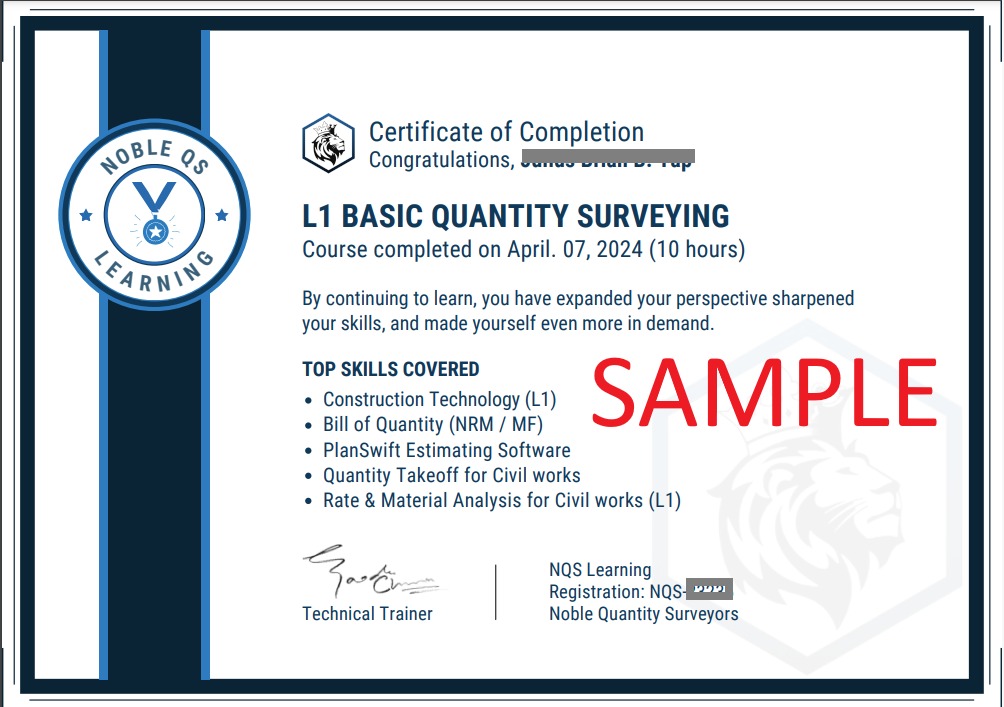
- Certificate of Completion
- Full Lifetime Access
- Resume Review
- Career Counselling
- FAQ Session with Trainer