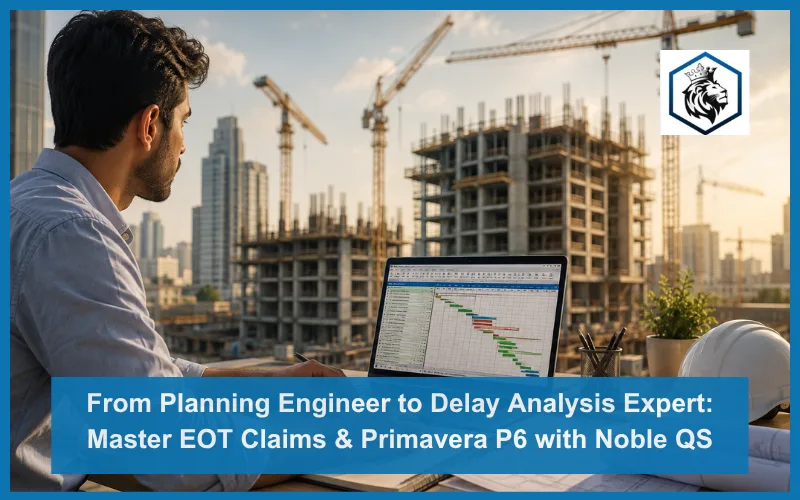
From Planning Engineer to Delay Analysis Expert: Master EOT Claims, Primavera P6 & International Contracts with Noble QS
Early in my career as a planning engineer, I thought my responsibility ended with preparing schedules, updating Primavera P6, monitoring progress, and reporting whether a project was ahead or behind schedule. Then came the first serious project delay—and suddenly, knowing that a project was late was not enough. I needed to understand why the delay happened, who was responsible, whether it was excusable, and whether the contractor was entitled to an Extension of Time (EOT). That experience made me realize that modern planning engineers need much more than scheduling skills; they need a strong understanding of delay analysis, claims, contracts, and project controls.
That is where Noble QS’s Delay Analysis, EOT & Claims with Primavera P6 & International Contracts course caught my attention. Instead of treating delay analysis as purely theoretical, the course takes the learner from scheduling fundamentals and Critical Path Method (CPM) to baseline and updated schedules, delay events, concurrent delays, float ownership, and compensable versus non-compensable delays. It then moves into practical AACE-recommended delay analysis methods, including Impacted As-Planned, Time Impact Analysis (TIA), As-Planned vs. As-Built, and Collapsed As-Built. Most importantly for a planning engineer, these techniques are implemented in Primavera P6, including prospective and retrospective TIA, window analysis, concurrent delay analysis, recovery schedules, revised schedules, and forensic delay analysis.
As my responsibilities grew, I also realized that a schedule alone cannot establish a claim. A good planning professional must understand the contract behind the programme. Noble QS therefore connects Primavera P6 with FIDIC and other international contract forms, including JCT, NEC, AIA, ConsensusDocs, ICE, and PPC2000. The course covers EOT provisions, contractor and employer obligations, entitlement and causation, claim documentation, prolongation and disruption costs, mitigation, recovery planning, and even dispute-resolution mechanisms such as adjudication and arbitration. With practical exercises, case studies, templates, and real-world examples, it helps bridge the gap between knowing Primavera P6 and actually using project records and schedules to build a professionally supported delay or EOT claim.
Looking back, I wish I had developed these skills earlier in my planning career. Today, Primavera P6, project planning, delay analysis, EOT claims, contracts, quantity surveying, estimation, and other construction-management skills are highly valuable and in demand across international markets. Noble QS is helping engineers, planners, QS professionals, and construction specialists move toward that future by creating practical learning opportunities designed to help professionals learn, earn, and grow. With learners enrolling from around the world and courses focused on industry-relevant knowledge and practical application, Noble QS is more than a training platform—it is an opportunity to turn learning into skills that can be applied on real projects and used to build a stronger global career.



0 comments