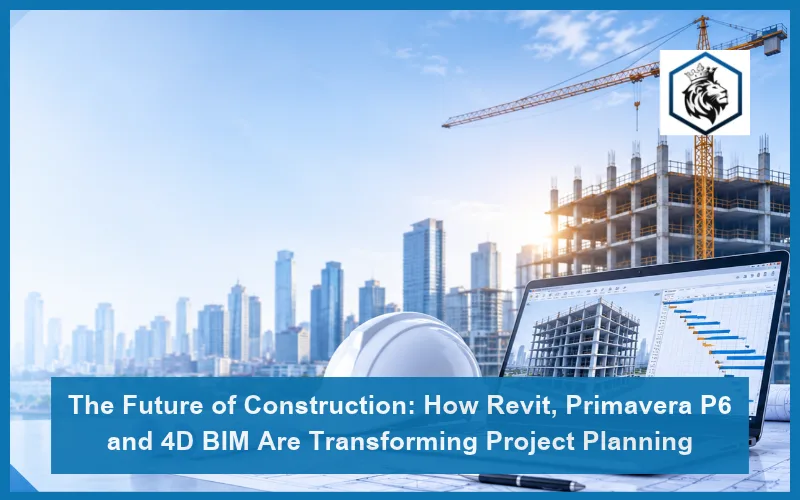
The Future of Construction: How Revit, Primavera P6 and 4D BIM Are Transforming Project Planning
The construction industry is undergoing a major digital transformation. Traditional methods of designing buildings, preparing project schedules, and monitoring construction progress are increasingly being complemented by advanced digital technologies. Today, construction professionals are expected not only to understand engineering principles but also to work with Building Information Modeling (BIM), advanced project scheduling software, and digital construction simulation tools. Among the technologies driving this transformation, Autodesk Revit, Oracle Primavera P6, and 4D BIM are becoming increasingly important for modern construction project delivery.
As construction projects grow in complexity, coordinating design, scheduling, resources, and site activities becomes more challenging. A three-dimensional building model provides valuable information about the physical structure, while a project schedule establishes when different activities should take place. By connecting these two elements through 4D construction simulation, project teams can visualize the entire construction process before actual work begins. This integrated approach is changing how engineers, planners, BIM professionals, and project managers plan and execute construction projects.
1. Building Information Modeling (BIM): The Shift Towards Smarter Construction
Building Information Modeling (BIM) has transformed the way construction projects are designed, coordinated, and managed. Unlike traditional two-dimensional drawings, BIM allows professionals to develop intelligent three-dimensional models containing detailed information about building components, materials, dimensions, and technical specifications.
Autodesk Revit is one of the widely used software platforms for developing BIM models across architectural, structural, and MEP disciplines. Engineers and designers can create coordinated models, identify design conflicts, extract project information, and improve communication between different project stakeholders.
The importance of Revit extends beyond creating visually detailed building models. Its information-rich environment supports design coordination, quantity extraction, construction documentation, and collaboration throughout different project stages. As the industry moves towards more connected digital workflows, BIM models are increasingly becoming valuable sources of information for construction planning and project management.
For civil engineers, architects, structural engineers, and BIM professionals, developing practical Autodesk Revit skills is an important step towards participating in modern digital construction workflows.
2. Primavera P6: The Foundation of Professional Construction Planning and Scheduling
While BIM helps project teams understand what they are building, effective project scheduling determines when and how construction activities will be executed. This is where Oracle Primavera P6 plays a significant role.
Primavera P6 is a professional project planning and scheduling software widely used in construction, infrastructure, oil and gas, engineering, and industrial projects. It enables planning engineers and project managers to develop comprehensive project programmes, organize activities, establish relationships, allocate resources, assign durations, and monitor project performance.
Through Primavera P6, professionals can develop Work Breakdown Structures (WBS), establish project baselines, perform Critical Path Method (CPM) analysis, monitor planned versus actual progress, and identify activities that may affect project completion dates.
For large-scale construction projects, a properly developed and regularly updated schedule is essential for managing project timelines, coordinating contractors, monitoring resources, and controlling delays. When combined with BIM-based information, the project schedule becomes even more valuable because planned construction activities can be connected to the actual building components they represent.
This is why Primavera P6 proficiency is increasingly valuable for planning engineers, project controls professionals, construction managers, and civil engineers seeking to strengthen their technical capabilities.
3. What Is 4D BIM? Connecting 3D Models with Time
The construction industry is moving beyond traditional 3D modeling towards 4D BIM, where the dimension of time is integrated with a three-dimensional building model.
In simple terms, 4D BIM combines a 3D BIM model with a construction schedule. Each relevant building component or group of components is associated with scheduled construction activities, allowing professionals to visualize how the project will develop over time.
For example, a building project may involve excavation, foundation construction, columns, beams, slabs, masonry, MEP installation, and finishing works. In a traditional schedule, these activities are represented through dates, durations, relationships, and Gantt charts. In a 4D BIM environment, the same activities can be shown through a simulated construction sequence, indicating when individual building elements are expected to be installed.
This gives project stakeholders a clearer understanding of construction sequencing, project milestones, work progress, and potential coordination challenges. Autodesk's construction simulation guidance also highlights how 4D workflows can support site logistics, equipment routing, material storage, and work-area coordination.
The result is a more visual and collaborative approach to construction planning, helping project teams move beyond static schedules towards more practical construction simulations.
4. How Revit and Primavera P6 Work Together in 4D Construction
One of the most valuable developments in digital construction is the integration of BIM models with project scheduling software. Revit and Primavera P6 serve different but complementary purposes in this workflow.
The process generally begins with developing a detailed 3D BIM model in Autodesk Revit. This model represents the building's architectural, structural, and MEP components. At the same time, the planning engineer develops a detailed construction programme in Primavera P6, defining activities, durations, relationships, milestones, and project timelines.
The next step is connecting the building model with the construction schedule through a 4D simulation platform such as Bentley SYNCHRO or Autodesk Navisworks. The relevant model components are linked with their corresponding schedule activities, creating a time-based construction simulation.
For example, when the Primavera P6 schedule indicates that foundation work will begin after excavation, the 4D model can visually demonstrate this sequence. As the simulation progresses, foundation elements appear first, followed by columns, beams, slabs, and other building components according to the planned construction programme.
This integrated workflow allows engineers and project managers to visualize the planned construction sequence, review activity relationships, identify potential scheduling conflicts, and communicate project requirements more effectively.
Importantly, Revit, Primavera P6, and the 4D simulation platform complement each other rather than replace one another. Their combined application creates a more connected digital construction planning process.
5. Key Benefits of 4D BIM for Construction Projects
The value of 4D construction planning goes beyond producing attractive project animations. When implemented as part of an actual project planning and control process, it can provide practical benefits throughout construction delivery.
One major advantage is improved construction sequencing. By visualizing the planned installation of building components, project teams can review activity order and identify potential conflicts before they affect site operations. This is particularly valuable for complex buildings, infrastructure developments, and projects involving multiple contractors.
Another important benefit is better communication between project stakeholders. Traditional schedules can be difficult for clients and non-technical stakeholders to interpret. A 4D simulation presents the construction programme visually, making project milestones, activity sequences, and expected progress easier to understand.
Four-dimensional planning can also support construction site logistics. Equipment movement, material storage, access routes, temporary work areas, and construction phases can be considered within the planning process. This helps teams identify potential space constraints and improve site coordination.
Furthermore, connecting schedule information with BIM models can support more informed progress monitoring. By comparing planned construction sequences with actual site conditions, project teams can better understand deviations, assess potential impacts, and develop appropriate recovery strategies.
However, these benefits depend on accurate models, reliable schedules, meaningful task-to-model linking, and regular updates. A 4D simulation is most valuable when it supports real project decisions rather than being used only as a presentation animation.
6. The Future of Digital Construction: From 4D BIM Towards 5D and Digital Twins
The development of digital construction does not stop at 4D BIM. The industry is increasingly exploring 5D BIM, digital twins, cloud-based collaboration, automation, and data-driven project management.
While 4D BIM introduces time and construction sequencing into the 3D model, 5D BIM extends the process by incorporating cost information. This allows project teams to connect building components, construction schedules, quantities, and estimated costs within a more integrated project environment.
For quantity surveyors and cost engineers, this creates opportunities to connect BIM-based quantity information with cost planning, estimating, and project cost control. For planning engineers, integrating time and cost information can provide better insight into project performance and the financial implications of schedule changes.
Digital twins take this concept further by connecting digital representations of physical assets with operational or real-time information. As construction technology continues to develop, professionals with knowledge of BIM, scheduling, cost management, and digital project controls will be better positioned to participate in these evolving workflows.
The future of construction management will increasingly depend on professionals who can understand and connect different technical disciplines rather than working with isolated software applications.
7. Essential Skills for Modern Construction Professionals
The growing importance of digital construction technologies is changing the skills expected from engineers and construction professionals. Employers increasingly value individuals who can combine technical engineering knowledge with practical software proficiency and project management capabilities.
Civil engineers and architects can strengthen their design and modeling expertise through Autodesk Revit. Planning engineers can improve their scheduling and project control capabilities through Primavera P6. Meanwhile, BIM professionals, construction managers, and project planners can expand their expertise by learning 4D construction simulation using specialized platforms such as Bentley SYNCHRO.
Understanding how these tools complement one another is particularly valuable. A professional who can develop or interpret a BIM model, understand a construction programme, and contribute to 4D simulation has a broader understanding of the digital construction process.
For fresh graduates, these skills can help bridge the gap between academic education and industry requirements. For experienced professionals, they provide opportunities to expand technical expertise, improve professional versatility, and pursue new responsibilities in BIM coordination, planning, scheduling, and project controls.
8. Learn Revit, Primavera P6 and 4D BIM with Noble QS
Understanding emerging construction technologies is only the first step. Developing the practical ability to use these tools is what makes a difference in professional environments.
At Noble QS, we believe that continuous learning and practical skill development are essential for building successful careers in the global Architecture, Engineering, and Construction (AEC) industry. Our online training platform provides specialized courses designed to help students, engineers, planners, and construction professionals strengthen their technical knowledge and develop industry-relevant skills.
Whether you want to begin your BIM journey with Autodesk Revit, develop professional project planning and scheduling capabilities through Primavera P6, or explore advanced construction simulation through 4D BIM with Bentley SYNCHRO, Noble QS offers dedicated learning opportunities to support your professional goals.
Our Autodesk Revit training courses provide opportunities to develop BIM modeling skills, while our Comprehensive Primavera P6 Training focuses on project planning, scheduling, monitoring, and controlling. For professionals interested in connecting 3D models with construction programmes, our 4D BIM with Bentley SYNCHRO: Construction Planning & Simulation course introduces the practical workflow of importing models and schedules, linking construction activities, and creating dynamic construction simulations.
With industry-focused instruction, flexible online learning, downloadable resources where provided, and lifetime course access, Noble QS makes professional training accessible to learners around the world.
Build Your Future in Digital Construction with Noble QS
The construction industry is moving towards smarter, more connected, and technology-driven project delivery. Revit, Primavera P6, and 4D BIM are important parts of this transformation, helping professionals connect design information, project schedules, and construction execution within a more coordinated workflow.
For engineers and construction professionals who want to remain competitive, developing these skills is no longer simply an additional qualification; it is an investment in long-term professional growth.
At Noble QS, our mission is to empower professionals with practical knowledge and industry-relevant training that supports their career development. Explore our professional courses, enhance your technical expertise, and prepare yourself for the evolving demands of the global construction industry.
Learn, Earn & Grow with Noble QS.
Visit www.nobleqs.com and explore our professional training courses today.


0 comments